
Introduction
Digital marketing has transformed dramatically over the past decade. What once relied heavily on simple websites, email campaigns, and banner ads has evolved into a data-driven ecosystem powered by artificial intelligence, automation, and personalized customer experiences. As we move beyond 2026, the pace of innovation is expected to accelerate even further, creating exciting opportunities and new challenges for businesses and marketers alike.
Consumer behavior continues to change alongside technological advancements. People expect brands to understand their needs, communicate through their preferred channels, and deliver personalized experiences in real time. At the same time, privacy concerns, emerging technologies, and evolving search engines are reshaping how businesses connect with their audiences.
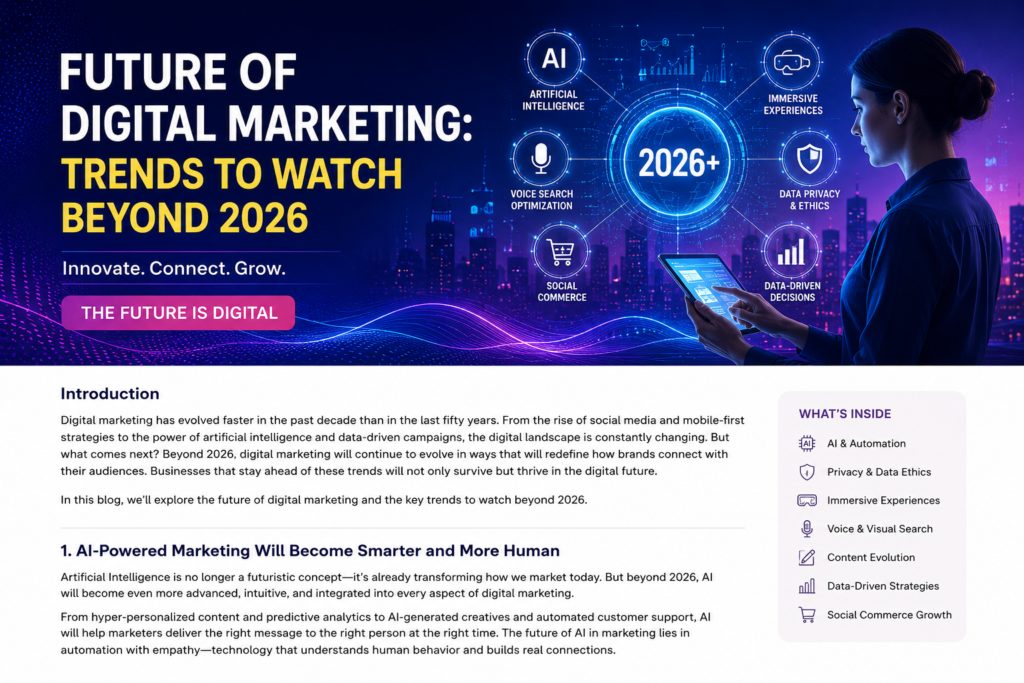
In this blog, we’ll explore the biggest digital marketing trends that are expected to define the future beyond 2026 and how businesses can prepare for the next generation of marketing.
1. Artificial Intelligence Will Lead Marketing Innovation
Artificial Intelligence (AI) is no longer just a trend—it has become an essential part of digital marketing. Beyond 2026, AI will play an even greater role in creating content, analyzing customer behavior, predicting trends, and automating repetitive tasks.
Marketers will increasingly use AI-powered tools to generate personalized email campaigns, social media posts, advertisements, and website content within minutes. AI chatbots will become more conversational, offering 24/7 customer support that feels almost human.
Instead of replacing marketers, AI will help them focus on creativity, strategy, and building stronger customer relationships.
2. Hyper-Personalization Will Become the Standard
Customers no longer respond well to generic advertisements. They expect brands to understand their interests, shopping habits, and preferences.
Future digital marketing will rely on real-time data to create highly personalized experiences. Websites, emails, product recommendations, and advertisements will automatically adapt to each visitor based on their behavior and preferences.
Businesses that deliver personalized experiences will enjoy higher customer satisfaction, stronger brand loyalty, and increased conversion rates.
3. Voice and Visual Search Will Continue to Grow
Voice assistants like Google Assistant, Alexa, and Siri have already changed the way people search online. Beyond 2026, voice search is expected to become even more common as smart devices become a part of everyday life.
Similarly, visual search technology allows users to upload an image instead of typing a search query. Consumers can simply take a photo of a product to find similar items online.
Businesses should optimize their websites with conversational keywords, structured data, and high-quality images to remain visible in both voice and visual search results.
4. Search Engine Optimization Will Focus on User Experience
SEO is evolving beyond keywords and backlinks. Search engines now prioritize websites that offer valuable, trustworthy, and user-friendly experiences.
Future SEO strategies will focus on:
- High-quality, helpful content
- Fast-loading websites
- Mobile-first design
- Core Web Vitals
- User engagement
- Search intent optimization
- AI-generated search experiences
Brands that consistently create informative and trustworthy content will achieve better visibility in search results.
5. Video Marketing Will Dominate Customer Engagement
Video has already become one of the most effective marketing formats, and its importance will only continue to grow.
Short-form videos on platforms like Instagram Reels, YouTube Shorts, and TikTok attract millions of users every day. Beyond 2026, interactive videos, live streaming, and AI-generated videos will become even more popular.
Businesses should focus on creating educational, entertaining, and authentic video content that captures attention within the first few seconds.
6. Social Commerce Will Transform Online Shopping
Social media platforms are evolving into complete shopping destinations. Consumers can now discover products, read reviews, watch demonstrations, and make purchases without leaving their favorite social apps.
This trend is expected to grow rapidly after 2026.
Brands will increasingly invest in:
- Live shopping events
- Influencer collaborations
- User-generated content
- Interactive product demonstrations
- In-app checkout experiences
Social commerce reduces the customer journey and makes online shopping faster and more convenient.
7. Privacy-First Marketing Will Become Essential
Consumers are becoming more aware of how their personal information is collected and used. Governments are also introducing stricter privacy regulations.
As third-party cookies disappear, businesses must focus on collecting first-party data directly from customers through newsletters, loyalty programs, surveys, and website interactions.
Transparency, trust, and ethical data practices will become competitive advantages for businesses that respect customer privacy.
8. Influencer Marketing Will Become More Authentic
Influencer marketing will continue to grow, but brands will shift their focus toward authenticity rather than follower count.
Micro-influencers and niche content creators often have stronger relationships with their audiences, resulting in higher engagement and better trust.
Successful partnerships will emphasize honest product reviews, storytelling, and long-term collaborations instead of one-time promotional posts.
9. Immersive Technologies Will Change Customer Experiences
Augmented Reality (AR) and Virtual Reality (VR) are creating exciting new opportunities for marketers.
Customers can already:
- Try on clothes virtually
- Preview furniture inside their homes
- Experience virtual property tours
- Test makeup products using AR filters
As these technologies become more affordable, immersive shopping experiences will become a regular part of digital marketing strategies.
10. Data Analytics Will Drive Smarter Decisions
Data has always been valuable, but future marketing success will depend on how effectively businesses interpret and use it.
Advanced analytics tools powered by AI will provide deeper insights into customer behavior, campaign performance, and future trends.
Businesses will increasingly make marketing decisions based on predictive analytics rather than guesswork, improving return on investment and customer satisfaction.
Skills Future Digital Marketers Should Develop
Technology will continue evolving, but human creativity and strategic thinking will remain irreplaceable. To stay competitive beyond 2026, digital marketers should focus on developing a balanced set of technical and soft skills.
Important skills include:
- Search Engine Optimization (SEO)
- Content Marketing
- AI Prompt Engineering
- Data Analytics
- Social Media Marketing
- Performance Marketing
- Email Marketing
- Marketing Automation
- Video Content Creation
- Copywriting
- Customer Psychology
- Communication Skills
- Critical Thinking
- Adaptability
Continuous learning will be essential in an industry where trends change rapidly.
Challenges Businesses May Face
While future digital marketing offers enormous opportunities, businesses will also encounter several challenges:
- Keeping up with rapidly changing technology
- Maintaining customer trust in a privacy-focused world
- Managing AI-generated content responsibly
- Standing out in an increasingly competitive digital space
- Adapting to new search engine algorithms
- Balancing automation with genuine human interaction
Businesses that embrace innovation while maintaining authenticity will be better positioned for long-term success.
Conclusion
The future of digital marketing beyond 2026 is exciting, dynamic, and full of possibilities. Artificial intelligence, personalized experiences, voice search, immersive technologies, privacy-first strategies, and advanced analytics will reshape how businesses connect with customers.
However, technology alone won’t guarantee success. The brands that thrive will be those that combine innovation with authenticity, creativity, and a deep understanding of customer needs. Digital marketers must remain curious, continuously update their skills, and adapt to emerging trends to stay ahead in an increasingly competitive landscape.
As the digital world continues to evolve, one thing remains constant: businesses that prioritize meaningful customer experiences and deliver real value will always have a competitive advantage. The future belongs to marketers who are ready to learn, innovate, and embrace change.